
Most students of International Relations practice Diplomatic dreaming rather than Californian dreaming. Unfortunately, the IR job market’s partial equilibrium suffers from increasing supply and perpetual low demand. Both the financial crisis and the ongoing health crisis have exacerbated this inverse trend and, as a result, competition in the field of international affairs is skyrocketing. Also, chances of any neo-Keynesian policymaker saving us by fostering full employment and leveling the playing field are, well, you know, slim. Luckily, our Institutional Chair Nelly Poehlman invited a speaker who has written International Affairs Career Guides for students, graduates, and young professionals. Delivering a boldly honest and yet highly motivating talk, Alexander Borum provided MAIR students and ISSA members with invaluable tips & tricks to land one of those much-desired IR jobs.
It’s gonna be tough
Alexander (Alex) Borum is a Leiden alumnus, Liaison and Policy Support Officer at EUCAP Somalia, member of the Peace and Stabilisation Response (PSR) under the Danish Ministry of Foreign Affairs, independent consultant and member of the Leiden University Mentor Network on a pro bono basis. That’s a lot for one person, right? Unsurprisingly, one of the ingredients of a career in IR that Alex emphasized during his talk is action. If you want to pursue a career in the field of international affairs and land a job as a diplomat or work with an NGO, modifications of ‘act’ (actor, active, action, actualization, etc.) must become inherent to your semantic vocabulary.
That dream job is not just coming to knock on your door some day. You must create the environment that allows this job to happen. You’ve got to actualize your dream job, recognize opportunity and be ready to jump and wave once that job passes by your door. Sometimes you’ll have to accept non-dream jobs prior to the real thing. Sometimes you’ll have to break down locked doors, build new doors or relocate your entire house to get the job. Competition is strong. It’s going to be tough. It’s going to take significant investments in terms of time and, indeed, money. But there’s good news. You can start today.

To what degree do we need a degree
Alex invited students to step into the shoes of those that review applications. Recruiters scan CVs with lightning speed and degrees are boxes to be checked on a large list of requirements. More often than not, the exact topic of study and the specific university do not matter that much. Recruiters’ main concern is the broader field of study and the fact that you have a degree. During the Q&A session, one ISSA member asked whether having two master’s degrees increases the chances to land an IR job. Well, if these degrees are very similar, Alex said, it doesn’t make that much of a difference. Furthermore, relevant experience outweighs degrees. Relevant experience is king.
Make a (s)killer CV
The first (and maybe the only) thing a recruiter is going to see of you is your CV. And Lord, possibilities to rock this part and make a good impression are endless! There’s lots of (free) templates available to create a topnotch CV and persuade recruiters to spend their expensive time on actually reading your CV. Therefore, you do need to make sure that your haute couture curriculum is tailored and smart. That is, 10 seconds of recruiter-staring is probably all you’ve got to make a good impression. That’s why Alex advises job seekers to have their CV checked by peers, family, friends, or even better, experts. Furthermore, as experience is king, start your CV with the professional experience part, followed by education, skills, and possibly miscellaneous information like hobbies and other unessential stuff (chances that you’ll be hired because you enjoy figure skating and Asian cuisine are relatively small). Last but not least, be aware of regional and national differences. In some cases a photograph is needed while in other cases it’s the norm to skip the personal picture.
Help, my CV is empty
Ah! That’s where it all starts. Necessity, mother of invention. The beauty of a tabula rasa is that there are unlimited possibilities to build. To quote Alex verbatim, ‘Your CV is only as good as the content in it, so go for bulking it up with anything of relevance’. How do you know what’s of relevance? Research. Do your homework: know your competition, determine core skills, and categorize supportive skills. Next, find ways to gain or develop these skills. One might think of certificates (free on Coursera), training, traineeships, internships, voluntary work, a part-time job, or a job in the private sector. Wait a sec, what was that? Private sector? Yes! Alex emphasized how a job in the private sector can be a very effective stepping stone towards your IR dream job, especially if it involves project management, program management, administration, analytics, or communication. Learn from today’s giants and Google contemporary IR figures. You’ll find out that most of them have lived a period of corporatism – let’s get real, business analyst does sound very fancy. When push comes to shove, Alex argues, any experience is better than no experience.
Realism, idealism and find-your-pathism
Hold on now. You’re a student, a student, and you’ve maybe got some vague ideas about awesome jobs with IOs and NGOs that allow you to travel the world while making it a better place but that’s about as specific as it gets. Here again, Alex says, you must do your research.
- Self-reflection: find out what interests you
- Research: Google relevant organizations, think thanks, advocacy groups, etc.
- Analysis: look at the jobs, roles, and functions they offer, and list the skills required for these positions
Not yet ready for this type of find-your-pathism? Start with why-how-whatism. Why do you do certain things, what drives you? How do you want to achieve your goals, what would the process look like? What are the jobs, roles, and functions in which your why and how meet each other? Now map out your options.
Systematic + systemagic = systemepic
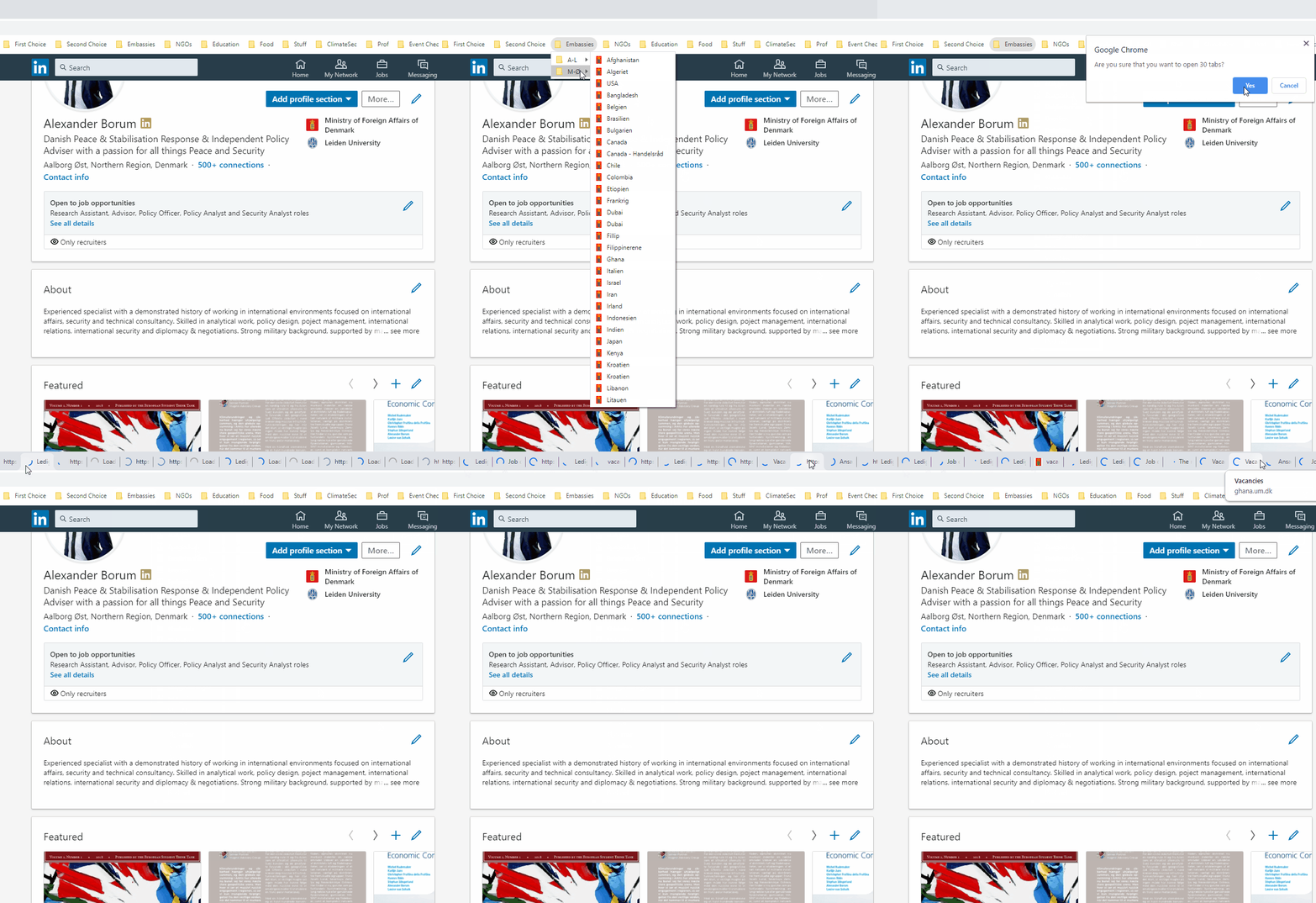
Alex teaches students and graduates an epic piece of magic mapping strategy, similar to the kind of systematic logging that makes writing a literature review a whole lot easier – and about which we usually find out only after submission. Build a database of relevant organizations and save deep links to the recruitment and career pages in bookmark folders. Maintain a log and list every single job you plan to apply for. This strategy saves you a big chunk of time and mental health. Additionally, thanks to mapping and logging, you can integrate biweekly moments of checking career pages and applying for jobs into your routine. In order to Pay it Forward, Alex created a template Log Book for IR Job Hunters that everyone can use freely. Kind of an aromatic cup of Neapolitan caffè sospeso: exactly what you need to wake up and start doing shit.
Professional personal branding
Let’s try something. Open a new tab and type in your full name in Google search. What does the first SERP (search engine results page) show? Your LinkedIn profile? Your Instagram or Facebook page? A Soundcloud account you haven’t used in ages? A ridiculous photo from a party in a faraway past you had forgotten (or wanted to forget) about? An offensive comment that the angry version of yourself once made on Twitter? Now picture the recruiter, you know, the very important and busy one. Besides a 10 second CV scan there’s going to be a quick Google check. Ouch. So, think about what you want the recruiter to find when looking you up online. Well, Alex knows: well-written and knowledgeable articles, professional LinkedIn posts and preferably a publication and a YouTube video of that public speaking event that you participated in 2 years ago. If that’s what you want the recruiter to find, then that’s the content that you’ve got create and put online.

You’ve got to be tough
Landing your IR dream job is going to be tough and therefore you must be equally tough or tougher. The higher your level of persistence and consistence, the greater the chances that you will start working a descent IR job within relatively little time after graduation. However, Alex notes, prepare for the long haul. You might get very lucky and land a satisfying IR job at the first try but it often takes months to years. Furthermore, the first IR job probably won’t be the real deal and you will keep searching, developing yourself both on a professional and personal level, and shaping your IR career as you go.
Happy IR job hunt
In the meantime, do not forget to be kind to yourself, Alex advises IR job hunters. Yes, you’ve got to work hard, but you also need quality time to relax and engage in activities that reward you with instant happiness (from Netflixing to traveling). Treat job hunting as if it were a job, taking breaks to distract your mind and remember that there’s a life to live, whether there’s an IR job or not. Furthermore, all roads lead to Rome and Rome wasn’t built in a day. There’s no ‘one path’ leading to landing a dream job, for the mere fact that the definition of a dream job depends on the person defining it. Be passionate, be patient, and never forget to enjoy the process.
Life is what happens to us while we are making other plans.
Allen Saunders

More info?
Obviously, this blog post didn’t cover everything Alexander Borum has talked about. He also spoke about the difference between active and passive networking, unpacked features of LinkedIn, the strategic relevance of the UN P-system and explained why asking for advice is the best decision you will ever make. For more information, read his Career Guides (links below), check his LinkedIn page or simply send him a message with your burning questions. Alex is always up for a discussion and grabs every possibility to help students find their footing in the world of International Affairs.
International Affairs Career Guides
Students Guide to a Career in International Affairs
Graduates Guide to a Career in International Affairs
Young Professionals Guide to a Career in International Affairs
Follow Alexander Borum
Author: Karin Dral


Leave a Reply